Designing Fault Tolerant Control Applications Using Sensor
Networks
Sensor-actuator networks are increasingly
being used in distributed control applications. The cost of sensors and actuators
is dropping substantially and hence control by a large number of these
components is now feasible. One such application is the damping of acoustic and
structural vibration associated with the launch of a rocket. Reliability in the
presence of faults is critical for such mission systems. These faults could be
broken components, insecure or compromised components offering erroneous data
to the control. The network itself could add unpredictable delays and data drop
outs that could affect the control in potentially unanticipated ways. In this
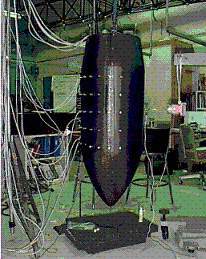
project, we considered the Boeing Open Experimental Platform fairing control
application for acoustic and structural vibration damping and study the effect
of component level and network level faults. We identified several scenarios
under which control performance is intolerable. We also designed a
fault-tolerant control scheme for linear systems that deals with Byzantine
faults of actuators.
Boeing Fairing
Simulator
Publications
1. V. Kulathumani, P. Shankar, Y. Kim, A.
Arora, and R. Yedavalli, Reliable Control System Design Despite
Byzantine Actuators, Fifth ASME International Conference on
Multibody Systems, Nonlinear Dynamics and Controls (MSNDC 2005)
2. Y. Kim, A. Arora, V. Kulathumani, U.
Arumugam, and S. Kulkarni, On the Effect of
Faults in Vibration Control of Fairing Structures, Fifth ASME International Conference on Multibody
Systems, Nonlinear Dynamics and Controls (MSNDC 2005)