


The first problem we wish to mention
here is connected with the Fubini-Tonelli
Theorem. The theorem says, in particular, that if a function
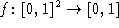 is measurable then the iterated integrals
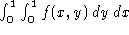 and
and 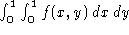 exist
and are both equal to the double integral
exist
and are both equal to the double integral  , where
  stands for the Lebesgue measure on
  . But what happens when f is
non-measurable? Clearly, then the double integral does not exist. However, the
iterated integrals might still exist. Must they be equal? The next theorem,
which is a classical example of an application of the Continuum Hypothesis in
real analysis, gives a negative answer to this question.
. But what happens when f is
non-measurable? Clearly, then the double integral does not exist. However, the
iterated integrals might still exist. Must they be equal? The next theorem,
which is a classical example of an application of the Continuum Hypothesis in
real analysis, gives a negative answer to this question.
PROOF. Let  be a well ordering of [0,1] in order type continuum
 and define
  . Let f
be the characteristic function
. Let f
be the characteristic function  of A. Then for every fixed
 the set
 is an initial
segment of a set ordered in type . So, by CH, it is at most
countable and
is an initial
segment of a set ordered in type . So, by CH, it is at most
countable and

Similarly, for each  the set
 is at most
countable and
is at most
countable and

Thus,
 .
.

Sierpinski's use of the Continuum Hypothesis in the construction of such a function begs the question whether such a function can be constructed using only the axioms of ZFC. The negative answer was given in the 1980's by Laczkovich [87], Friedman [60] and Freiling [54], who independently proved the following theorem.
It is also worthwhile to mention that the function f from the proof of
Theorem 2.2 has the desired property as long as every subset of
 of cardinality less than continuum has measure zero, i.e., when the
smallest cardinality
of cardinality less than continuum has measure zero, i.e., when the
smallest cardinality  of the non-measurable subset of is
equal to . Since the equation
of the non-measurable subset of is
equal to . Since the equation  holds in many
models of ZFC in which CH fails (for example, it is implied by MA)
Theorem 2.2 is certainly not equivalent to CH. On the other hand,
Laczkovich proved Theorem 2.2 by noticing that: (A) the
existence of an example as in the statement of Theorem 2.2
implies the existence of such an example as in its proof, i.e., in form of
; (B) there is no set
holds in many
models of ZFC in which CH fails (for example, it is implied by MA)
Theorem 2.2 is certainly not equivalent to CH. On the other hand,
Laczkovich proved Theorem 2.2 by noticing that: (A) the
existence of an example as in the statement of Theorem 2.2
implies the existence of such an example as in its proof, i.e., in form of
; (B) there is no set  with
with  satisfying Theorem 2.2 if
 , where
  is the smallest cardinality of a
covering of by the sets of measure zero. (It is well known that the
inequality
is consistent with ZFC.)
is the smallest cardinality of a
covering of by the sets of measure zero. (It is well known that the
inequality
is consistent with ZFC.)
A discussion of a similar problem for the functions
 and the n-times iterated integrals can be found
in a 1990
paper of Shipman [123]. The same paper contains also
two easy ZFC examples of measurable functions
and the n-times iterated integrals can be found
in a 1990
paper of Shipman [123]. The same paper contains also
two easy ZFC examples of measurable functions
 and
and 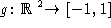 for which the iterated integrals exist but are not equal.
Thus, the restriction of the above problem to
the non-negative functions is essential.
for which the iterated integrals exist but are not equal.
Thus, the restriction of the above problem to
the non-negative functions is essential.
Another classical result arises from a different theorem of Sierpinski of 1928.
The set S from the original proof of Theorem 2.3 is
called Sierpinski set and it has the property that its intersection
 with any measure zero set N is at most countable.
 Another set that satisfies the conclusion of
Theorem 2.3, known as Luzin set (see [126]
or [127, property C
Another set that satisfies the conclusion of
Theorem 2.3, known as Luzin set (see [126]
or [127, property C ,]), is defined as an uncountable subset L of
whose intersection
,]), is defined as an uncountable subset L of
whose intersection
 with any meager set M is at most countable.
The existence of a
Luzin set is also implied by CH. In fact, the constructions of sets S and L
under the assumption of CH are almost identical: you list all G
with any meager set M is at most countable.
The existence of a
Luzin set is also implied by CH. In fact, the constructions of sets S and L
under the assumption of CH are almost identical: you list all G measure
zero sets (F
measure
zero sets (F meager sets) as
  and
define S (L, respectively) as a set
and
define S (L, respectively) as a set  where
where
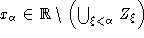 . The choice is
possible since, by CH, the family
. The choice is
possible since, by CH, the family
 is at most countable implying that its union is not
equal to .
is at most countable implying that its union is not
equal to .
It is also easy to see that this construction can be carried out if
 (and its category analog
  in case of
construction of L). The sets constructed that way are called generalized
Sierpinski and Luzin sets, respectively, and they also satisfy the conclusion
of Theorem 2.3 independently of the size of . Since
many models of ZFC satisfy either
or (for example, both conditions are
implied by MA) is has been a difficult task to find a model of ZFC in which the
conclusion of Theorem 2.3 fails. It has been found by A. W. Miller
in 1983.
in case of
construction of L). The sets constructed that way are called generalized
Sierpinski and Luzin sets, respectively, and they also satisfy the conclusion
of Theorem 2.3 independently of the size of . Since
many models of ZFC satisfy either
or (for example, both conditions are
implied by MA) is has been a difficult task to find a model of ZFC in which the
conclusion of Theorem 2.3 fails. It has been found by A. W. Miller
in 1983.
In his proof of Theorem 2.4 Miller used the iterated perfect set model, which will be mentioned in this paper in several other occasions.
Some of the most recent set-theoretic results concerning classical problems in real functions are connected with a theorem of Blumberg from 1922.
The set D constructed by Blumberg is countable. In a quest whether it can be chosen any bigger Sierpinski and Zygmund proved in 1923 the following theorem.
Theorem 2.6 immediately implies the following corollary, which shows that there is no hope for proving in ZFC a version of the Blumberg theorem in which the set D is uncountable.
The proof of Theorem 2.6 is a straightforward transfinite induction
diagonal argument after noticing that every continuous partial function on
can be extended to a continuous function on a G set.
Corollary 2.7 raises the natural question about the importance of the assumption of CH in its statement. Is it consistent that the set D in Blumberg Theorem can be uncountable? Can it be of positive outer measure, or non-meager?
The cardinality part of these questions is addressed by the following theorem of Baldwin from 1990.
Thus under MA the size of the set D is clear. By Theorem 2.6 it cannot
be chosen of cardinality continuum (at least for some functions), but it can be
always chosen of any cardinality  less than .
One might still hope to be able to prove in ZFC that for any f the set D
can be found of an arbitrary cardinality  . However, this is false
as well, as noticed by Shelah in his paper from 1995.
. However, this is false
as well, as noticed by Shelah in his paper from 1995.
The category version of a question on a size of D has been also settled by Shelah in the same paper.
The measure version of the question is less clear. It has been noticed by J. Brown in 1977 that the precise measure analog of Theorem 2.10 cannot be proved. (This has been also noticed independently by K. Ciesielski, whose proof is included below.)
PROOF. Let  be a partition of such that
 is a dense G set of measure zero and
 is nowhere dense for each n>0. Define
  by putting
f(x)=n for
by putting
f(x)=n for  . Now,
  is discontinuous for any dense
 which is nowhere measure zero.
Indeed, if is dense and nowhere measure zero then there exists
 . Now, if every open set U containing x intersects
 for infinitely many n then is discontinuous at
x. Otherwise, there is an open set U containing x and intersecting only
finitely many 's. So, we can find a non-empty open interval
for infinitely many n then is discontinuous at
x. Otherwise, there is an open set U containing x and intersecting only
finitely many 's. So, we can find a non-empty open interval  such that
  . But this means that
  has measure zero,
a contradiction.
has measure zero,
a contradiction.
However, the following problem asked by Heinrich von Weizsäcker [59, Problem AR(a),] remains open.
Other generalizations of Blumberg's theorem can be also found in a 1994 survey article [11]. (See also recent papers [12] and [68].)
In the past few years a lot of activity in real analysis was concentrated around
symmetric properties of real functions. (See Thomson [138].) Recall that a
function is symmetrically continuous at  if
if

and f is approximately symmetrically differentiable at x if there exists
a set  such that
x is a (Lebesgue) density point of
such that
x is a (Lebesgue) density point of  and that the following
limit exists
and that the following
limit exists

This limit, which does not depend on the choice of a set S, is called
the approximate symmetric derivative of f at x and is denoted by
 . We will say that f has a co-countable symmetric
derivative at x and denote it by
. We will say that f has a co-countable symmetric
derivative at x and denote it by  if the set S in the above
definition can be chosen to be countable.
if the set S in the above
definition can be chosen to be countable.
One of the long standing conjectures (with several incorrect proofs given earlier, some even published) was settled by Freiling and Rinne in 1988 by proving the following theorem.
The importance of the measurability assumption in Theorem 2.12 was long known from the following theorem of Sierpinski of 1936.
In fact, in [128] Theorem 2.13 is
stated in a bit stronger form from which it follows
immediately that the theorem remains true under MA, if the co-countable
symmetric derivatives are replaced by the approximate symmetric
derivatives  . However, neither Theorem 2.13 nor its
version with can be proved in ZFC. This follows from the following
two theorems of Freiling from 1990.
. However, neither Theorem 2.13 nor its
version with can be proved in ZFC. This follows from the following
two theorems of Freiling from 1990.
Thus the existence of a function as in Theorem 2.13 is in fact equivalent to the Continuum Hypothesis.
More precisely, Freiling proves that the conclusion of
Theorem 2.15 follows the property that is just a bit stronger than
the inequality . (Compare comment following
Theorem 2.2.)
Another direction in which the symmetric continuity research went was the study
of how far symmetric continuity can be destroyed. First note that clearly every
continuous function is symmetrically continuous, but not vice versa, since the
characteristic function of a singleton is symmetrically continuous. However, it
is not difficult to find functions which are nowhere symmetrically continuous.
For example, the characteristic function of any dense Hamel basis is such a
function.
How much more can we destroy symmetric continuity?
In the non-symmetric case probably the weakest (bilateral) version of
continuity that can be defined is the following. A function
is weakly continuous at x if there
are sequences  and
and  such that

This notion is so weak that it is impossible to find a function
which is nowhere weakly continuous. This follows from the
following easy, but a little surprising theorem.
A natural symmetric counterpart of weak continuity is defined as follows. A
function is weakly symmetrically continuous at x
if there is a sequence  such that

However, the symmetric version of Theorem 2.16 badly fails: there
exist nowhere weakly symmetrically continuous functions (which are also called
uniformly antisymmetric functions). Their existence follows immediately
from the following theorem of Ciesielski and Larson from 1993.
The function f from Theorem 2.17 raises the questions in two directions. Can the range of f be any smaller? Can the size of all sets be uniformly bounded? The first of this questions leads to the following open problem from [33]. (See also problems listed in [138].)
Concerning part (a) of this problem it has been proved in 1993 by Ciesielski [25] that the range of uniformly antisymmetric function must have at least 4 elements. (Compare also [27].)
The estimation of sizes of sets  from Theorem 2.17 has been
examined by Komjáth and Shelah in 1993, leading to the following two
theorems.
from Theorem 2.17 has been
examined by Komjáth and Shelah in 1993, leading to the following two
theorems.
Theorem 2.18 suggests that the converse of Theorem 2.19 should also be true. However, this is still unknown, leading to another open problem.
For k=0 the positive answer is implied by Theorem 2.18. Also, it is
consistent that  and there exists
 such that each
has at most
such that each
has at most  elements. This follows from another theorem of
Komjáth and Shelah
[84, Thm 1,]. (See also a paper [28] of Ciesielski
related to this subject.)
elements. This follows from another theorem of
Komjáth and Shelah
[84, Thm 1,]. (See also a paper [28] of Ciesielski
related to this subject.)
In fact, the proof of Theorem 2.17 gives also the following version
for functions on
 :
:
 such that the set

 .
.

Thus, this theorem says, that there exists (in ZFC) a countable partition of
such that no three vertices a,b,x spanning isosceles triangle
belong to the same element of the partition.





















