Consider the functions  from
from  onto
onto  . By a well
known theorem of Peano from 1890 (see e.g. [117]) such an F can be
continuous. However, it is not difficult to see that it cannot be
differentiable. It follows easily from the fact that every differentiable
function
. By a well
known theorem of Peano from 1890 (see e.g. [117]) such an F can be
continuous. However, it is not difficult to see that it cannot be
differentiable. It follows easily from the fact that every differentiable
function
 satisfies the Banach condition
  , i.e., the set
 has Lebesgue measure zero. (See
e.g. [118, Chap. VII, p. 221,].) Thus, Morayne in 1987 considered the
following question: can function be chosen in such a way that
at every point
has Lebesgue measure zero. (See
e.g. [118, Chap. VII, p. 221,].) Thus, Morayne in 1987 considered the
following question: can function be chosen in such a way that
at every point  either
  or
or  is differentiable? The
surprising answer is given below.
is differentiable? The
surprising answer is given below.
The proof of this theorem is based on a well known theorem of Sierpinski
[127, Property  ,] from 1919 that CH is equivalent to the existence of
a decomposition of into two sets A and B such that all horizontal
section of A and all vertical section of B are at most countable. It is
also worthwhile to point out that the function F from Theorem 3.1
is not a Peano curve, since it is not continuous. In fact Morayne proves in the
same paper that for such an it is impossible that even one of
or is measurable.
,] from 1919 that CH is equivalent to the existence of
a decomposition of into two sets A and B such that all horizontal
section of A and all vertical section of B are at most countable. It is
also worthwhile to point out that the function F from Theorem 3.1
is not a Peano curve, since it is not continuous. In fact Morayne proves in the
same paper that for such an it is impossible that even one of
or is measurable.
Next, recall that if two continuous functions  agree on
some dense set
agree on
some dense set  then they are equal. Does the statement remain
true if the clause ``agree on M'' is replaced by ``f[M]=g[M]?'' Clearly not,
as shown by
then they are equal. Does the statement remain
true if the clause ``agree on M'' is replaced by ``f[M]=g[M]?'' Clearly not,
as shown by  and any two different rational translations of the
identity function. What about finding some more complicated set
for which the implication
and any two different rational translations of the
identity function. What about finding some more complicated set
for which the implication

holds for any continuous f and g? Even this is too much to ask, as
recently noted by Burke and Ciesielski
[18, Remark 6.6,]. On the other hand, the following theorem of Berarducci
and Dikranjan from 1993 gives a positive (consistent) answer to this question in
the class of continuous nowhere constant functions. (Function is nowhere
constant if it is not constant on any non-empty open set.)
The construction of a magic set, given in [8], is done by an easy diagonal
transfinite induction argument, and uses only the assumption that less than
continuum many meager sets do not cover . In particular, CH can be
replaced by MA in Theorem 3.2.
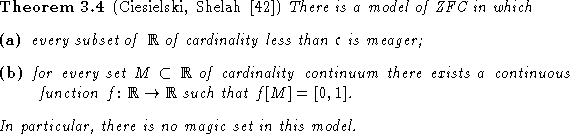
Examining the problem of existence of a magic set in ZFC Burke and Ciesielski noticed the following properties of a magic set.
In fact part (b) of Theorem 3.3 is just a remark: if there were a
continuous with  then it could be easily
modified to a nowhere constant function such that
then it could be easily
modified to a nowhere constant function such that  , and the
functions f and g=1+f would give a contradiction. But (b) shows that there
is no magic set of cardinality continuum in the model from
Theorem 2.4, the iterated perfect set model. Although it was
noticed in [18] that in this model there exists a magic set (clearly of
cardinality less than
, and the
functions f and g=1+f would give a contradiction. But (b) shows that there
is no magic set of cardinality continuum in the model from
Theorem 2.4, the iterated perfect set model. Although it was
noticed in [18] that in this model there exists a magic set (clearly of
cardinality less than  ), Theorem 3.3 was used by
Ciesielski and Shelah as a base in proving that magic set cannot be constructed
in ZFC.
), Theorem 3.3 was used by
Ciesielski and Shelah as a base in proving that magic set cannot be constructed
in ZFC.
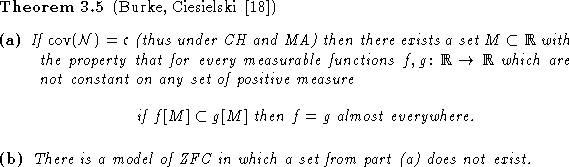
The magic sets for different classes of functions have also been considered. Burke and Ciesielski [18] studied such sets (which they call sets of range uniqueness) for the classes of measurable functions with respect to abstract measurable spaces with negligibles. In particular, they proved the following theorem concerning the Lebesgue measurable functions.
The model satisfying Theorem 3.5(b) is a modification the iterated
perfect set model and was constructed by Corazza [46] in 1989. Once
again it satisfies property (b) of Theorem 3.4, while part (a) is
replaced by  . It has been also proved by Ciesielski and
Larson that for the class of
. It has been also proved by Ciesielski and
Larson that for the class of  functions (continuously differentiable) the
existence of a magic set can be proved in ZFC.
functions (continuously differentiable) the
existence of a magic set can be proved in ZFC.
For the following consideration recall that a function  is
Darboux (or has the Darboux property) if f[C] is connected for
every connected subset C of
is
Darboux (or has the Darboux property) if f[C] is connected for
every connected subset C of  . Thus, in case of n=1 Darboux functions
are precisely the functions for which the Intermediate Value Theorem holds. The
class of Darboux functions will be denoted here by
. Thus, in case of n=1 Darboux functions
are precisely the functions for which the Intermediate Value Theorem holds. The
class of Darboux functions will be denoted here by  (with n clear from the
context, usually n=1).
(with n clear from the
context, usually n=1).
The class of Darboux functions has been studied for a long time as one of
possible generalizations of the class of continuous functions. (Clearly every
continuous function is Darboux.) However, it has some peculiar properties. For
example, it is not closed under addition. In fact, in 1927 Lindenbaum [92]
noticed (without a proof) that every function can be
written as a sum of two Darboux functions. (For proofs, see [129, ].)
This theorem has been improved in several ways. Erdos [52] showed
that if f is measurable, both of the summands can be chosen to be measurable.
Another improvement was done by Fast [53] in 1974 who proved that for every
family
 of real functions that has cardinality continuum there is just one
Darboux function
g such that the sum of g with any function in has the Darboux
property. The natural question of whether such a ``universal'' summand exists
also for families of larger cardinality has been studied by Natkaniec [104]
and lead to the development described in Section 4.
of real functions that has cardinality continuum there is just one
Darboux function
g such that the sum of g with any function in has the Darboux
property. The natural question of whether such a ``universal'' summand exists
also for families of larger cardinality has been studied by Natkaniec [104]
and lead to the development described in Section 4.
A problem that is in some sense opposite to the existence of a ``universal''
summand is for which families of functions there is a ``universally
bad'' Darboux function g, in the sense that the sum of g with any function
in
does not have the Darboux property. In 1990 Kirchheim and Natkaniec
addressed this problem for the class of continuous nowhere constant
functions.
The problem whether the additional set-theoretic assumptions are necessary in this theorem was investigated in 1992 by Komjáth [81] and was settled in 1995 by Steprans.
A model having this property is the iterated perfect set model. Note also that in Theorem 3.7 the restriction to the nowhere constant functions is important. This has been proved independently by T. Natkaniec (in his 1992/93 paper [106]) and by J. Steprans (in the 1995 paper mentioned above).
To state farther results recall the following generalizations of continuity. A
function is almost continuous (in sense of Stallings)
if each open subset of  containing the graph of
f contains also a continuous function from to [132].
Function has a perfect road at
if there exists a perfect set C such that x is a bilateral limit
point of C and
containing the graph of
f contains also a continuous function from to [132].
Function has a perfect road at
if there exists a perfect set C such that x is a bilateral limit
point of C and  is continuous at x [97]. The classes
of all almost continuous functions and all functions having a perfect road at
each point are denoted by
is continuous at x [97]. The classes
of all almost continuous functions and all functions having a perfect road at
each point are denoted by  and
and  , respectively. It is easy to
see that
, respectively. It is easy to
see that  (for functions on ) and that the
inclusions are strict (see e.g. [13]), where
(for functions on ) and that the
inclusions are strict (see e.g. [13]), where  stands for the class of
all continuous functions. We will also consider the class
stands for the class of
all continuous functions. We will also consider the class  of
Sierpinski-Zygmund (SZ-) functions, i.e., functions
whose restrictions
of
Sierpinski-Zygmund (SZ-) functions, i.e., functions
whose restrictions  are discontinuous for all subsets X of
of cardinality continuum. (That is, functions from Theorem 2.6.)
are discontinuous for all subsets X of
of cardinality continuum. (That is, functions from Theorem 2.6.)
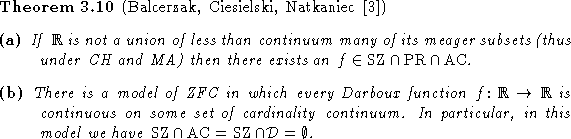
The classes and recently appeared in a 1993 paper of Darji
[47], who constructed in ZFC a function  . Answering
a question posed by Darji, this year Balcerzak, Ciesielski and Natkaniec proved
the following theorem.
. Answering
a question posed by Darji, this year Balcerzak, Ciesielski and Natkaniec proved
the following theorem.
The model satisfying Theorem 3.10(b) is, once again, the iterated perfect set model.
Another generalization of continuity is that of countable continuity: a
function is is countably continuous if there exists a
countable partition  of such that the
restriction of f to any
of such that the
restriction of f to any  is continuous. (See also
Section 4.) In 1995 Darji gave the following combinatorial
characterization of this notion.
is continuous. (See also
Section 4.) In 1995 Darji gave the following combinatorial
characterization of this notion.
The characterization ( ) cannot be proved in ZFC. This follows from a
result of Cichon and Morayne [20] from 1988 which implies that in some
models of ZFC (actually, when
) cannot be proved in ZFC. This follows from a
result of Cichon and Morayne [20] from 1988 which implies that in some
models of ZFC (actually, when
 and
and  , where d is the dominating number)
() is false. However, it is not known, whether the equivalence ()
can be proved in absence of CH, leading to the following open problem.
, where d is the dominating number)
() is false. However, it is not known, whether the equivalence ()
can be proved in absence of CH, leading to the following open problem.
Another recent theorem concerning countable and symmetric continuities is the following theorem of Ciesielski and Szyszkowski, answering a question of L. Larson.
We will finish this section with the following two interesting results. The first one has been proved independently in 1978 by Grande and Lipinski and in 1979 by Kharazishvili.
This theorem has important consequences concerning the existence of solutions of
the differential equation  in the class of absolutely
continuous functions. In 1992 Balcerzak [2] showed that in
Theorem 3.13 the CH assumption can be weakened to
in the class of absolutely
continuous functions. In 1992 Balcerzak [2] showed that in
Theorem 3.13 the CH assumption can be weakened to
 . However, the following problem remains open.
The second result is the following 1974 theorem of R. O. Davies.
Note that Theorem 3.14 is related to Hilbert's Problem 13
(from his famous Paris lecture of 1900)
and a 1957 theorem of Kolmogorov, in which he proves
that every continuous function 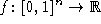 can be represented in a certain form (similar to the above) by
continuous functions of one variable.
An interesting account on this and related results
can be found in a 1984 paper of
Spreceher [133].
can be represented in a certain form (similar to the above) by
continuous functions of one variable.
An interesting account on this and related results
can be found in a 1984 paper of
Spreceher [133].