The important recent developments in set theoretical analysis concern the cardinal functions that are defined for different classes of real functions. These investigations seem to be analogous to those concerning of cardinal functions in topology from the 1970's and 1980's. (See [71, 67, 72, 139].) They are also related to the deep studies of cardinal invariants associated with different small subsets of the real line. (For a summary of the results concerning cardinals related to the measure and category see [57] or [7]. For a survey concerning cardinals associated with the thin sets derived from harmonic analysis see [17].)
The first group of functions is motivated by the notion of countable continuity
and was introduced in 1991 by J. Cichon, M. Morayne, J. Pawlikowski, and
S. Solecki in [21]. More precisely, they define the
decomposition function
 for arbitrary families
  and
and
 , where
  stands for the
set of all functions from X to Y.
stands for the
set of all functions from X to Y.

where  denotes the family of all coverings of
  with at
most
with at
most  many sets. In particular, if
  stands for the family of all
continuous functions (from subsets of into ) then
stands for the family of all
continuous functions (from subsets of into ) then

In [21] the authors considered the values of
 for
for  , where
 stands for the functions of
  -th Baire class.
The motivation for this definition comes from a question of N. N. Luzin
whether every Borel function is countable continuous.
This question was answered negatively by P. S. Novikov (see [74])
and was subsequently generalized by Keldys [74]
(in 1934), and S. I. Adian and P. S. Novikov [1] (in 1958).
The most general result in this direction was obtained in late 1980's
by M. Laczkovich [88], who proved, in particular, that
 for every .
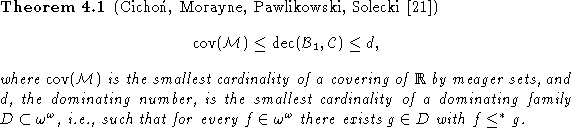
One of the most interesting results from the paper [21] is the following theorem.
It has been also shown by J. Steprans and S. Shelah that none of these inequalities can be replaced by the equation.
There are also some interesting results concerning the value of  ,
where
,
where  is the class of all (partial) differentiable functions. It has been
proved by Morayne
[136, Thm 6.1,] that
is the class of all (partial) differentiable functions. It has been
proved by Morayne
[136, Thm 6.1,] that
Also, Steprans proved that
However, the relation between numbers  ,
,
 and
for
and
for  is unclear.
In the same direction, K. Ciesielski recently noticed that (obviously)

and that it is the best that can be said in ZFC.
In fact, (1) happens in a model obtained by extending a ground model with GCH
by adding many Cohen reals. The equation  follows
immediately from Theorem 2.9.
follows
immediately from Theorem 2.9.
The model for (2) is obtained as follows.
You start with a model with GCH,
assume that  and take an increasing sequence
  cofinal with
  and such that each
  is a cardinal successor.
The desired model is obtained by a generic extension
via forcing P which a finite support iteration of forcings
is a cardinal successor.
The desired model is obtained by a generic extension
via forcing P which a finite support iteration of forcings
 , where each is a standard ccc forcing
adding the Martin's Axiom over the previous model and making
, where each is a standard ccc forcing
adding the Martin's Axiom over the previous model and making
 .
.
The second group of cardinal functions is defined in terms of algebraic
operations on functions. Their definition was motivated by the following
property of Darboux functions (from to ) due to Fast and mentioned in
the previous section:
 of almost
continuous functions and in 1991 Natkaniec [104] defined the following
cardinal functions for every
of almost
continuous functions and in 1991 Natkaniec [104] defined the following
cardinal functions for every  to study these phenomena
more closely.
to study these phenomena
more closely.

 is added in the definition of
  since otherwise
for every family
since otherwise
for every family  containing constant zero function
 we would have
  .
.
Its easy to see that the functions  and are monotone in a sense
that
and are monotone in a sense
that
 and
and  for every
 . Also clearly (1) is false for
 . Thus, in language of the function Fast and
Kellum's results can be expressed as follows:
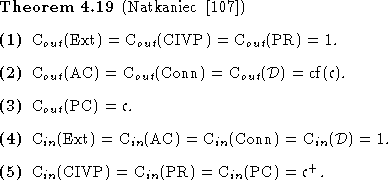
. Thus, in language of the function Fast and
Kellum's results can be expressed as follows:

If  (so, under the Generalized Continuum
Hypothesis GCH) the values of
(so, under the Generalized Continuum
Hypothesis GCH) the values of  and
and  are clear:
 . Thus, Natkaniec
asked [104, p. 495,] (see also [63, Problem 1,]) whether the equation
. Thus, Natkaniec
asked [104, p. 495,] (see also [63, Problem 1,]) whether the equation
 can be proved in ZFC.
This question was investigated by Ciesielski and Miller in 1994. They proved
that 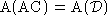 , that the cofinality
  of
is greater than
of
is greater than  and that this, together with the
inequalities
and that this, together with the
inequalities
 is essentially all that can be proved
in ZFC.
is essentially all that can be proved
in ZFC.
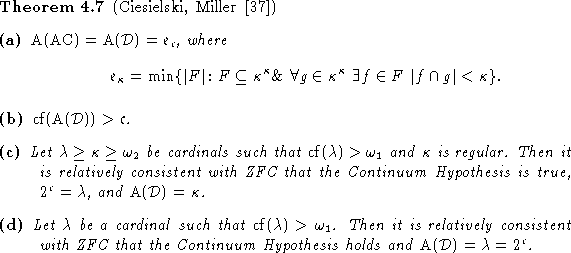
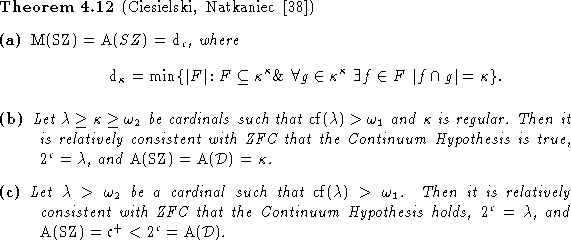
In particular, Theorem 4.7 says that
does not have to be a regular cardinal (part (d)) and that
can be any regular cardinal number between
 and
and  , with being ``arbitrarily large'' (part (c)).
At the same time Natkaniec and Rec aw established the values of
 and
and  proving
The first systematic study of functions and was done by
Ciesielski and Rec aw in the later part of 1995. They collected basic
properties of operators and , which are stated below, and
found the values of and for some other classes of functions.
In particular, (4) from Proposition 4.9 shows
that every function is a difference of two functions from a class  if and
only if
if and
only if  .
.
To state the other results from [41] recall the definitions the following classes of functions, where X is an arbitrary topological space.
 of connectivity functions
  , i.e., such
that the graph of f restricted to C (that is
, i.e., such
that the graph of f restricted to C (that is  )
is connected in
)
is connected in  for every connected subset C of X.
 of extendable functions , i.e., such that
there exists a connectivity function
of extendable functions , i.e., such that
there exists a connectivity function  with f(x)=g(x,0) for every
  .
.
 of peripherally continuous functions ,
i.e., such that
for every and any pair
of peripherally continuous functions ,
i.e., such that
for every and any pair  and
and  of
open neighborhoods of x and f(x), respectively,
there exists an open neighborhood W of x with
of
open neighborhoods of x and f(x), respectively,
there exists an open neighborhood W of x with
 and
and 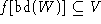 , where
  and
and  stand for the closure and the boundary of W,
respectively.
stand for the closure and the boundary of W,
respectively.
 ,
,  and
and  in place of , , and if
 . Notice also, that
  if and only if f is weakly continuous,
as defined on page
if and only if f is weakly continuous,
as defined on page  .
.
For the generalized continuity classes of functions (from into )
defined so far we have the following proper inclusions  , marked by
arrows
, marked by
arrows
 . (See [13].)
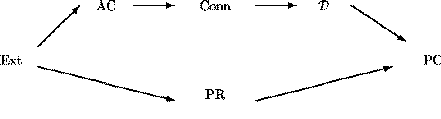
Chart 1.
In particular, inclusions  , monotonicity of and Theorem 4.7(a) imply that
 . Similarly, Theorem 4.8 implies
that
. Similarly, Theorem 4.8 implies
that  . The values of and for
the remaining classes are as follows.
. The values of and for
the remaining classes are as follows.
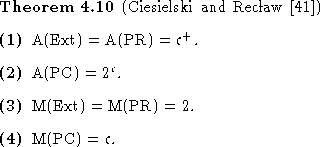
Notice also that
 . Thus, by monotonicity of
and the above theorem we obtain the following corollary.
. Thus, by monotonicity of
and the above theorem we obtain the following corollary.
The values of functions and for the class  has been
studied by Ciesielski and Natkaniec. First they noticed that
if the definition of from page is used
then trivially
has been
studied by Ciesielski and Natkaniec. First they noticed that
if the definition of from page is used
then trivially  , since for any function
 with
with  for some
  we have
  for every
  .
Thus, they modified the definition of
.
Thus, they modified the definition of  to
to

where

(Note that  is equal to
  as defined on page .)
With this agreement in place they proved the following result.
as defined on page .)
With this agreement in place they proved the following result.
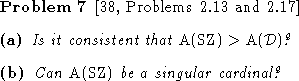
However, the following problems remain open.
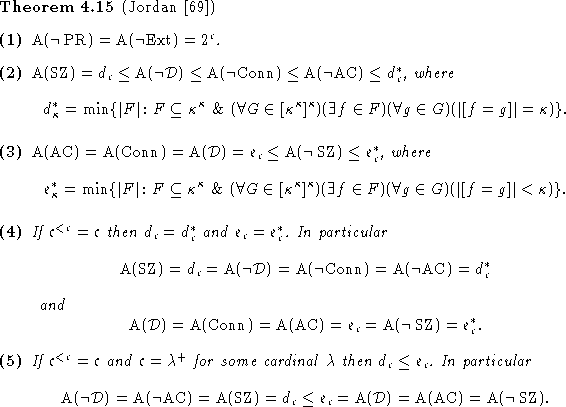
Another systematic study of operator was done by F. Jordan in 1996. In
his study, he examined the values of  where
where
 and classes are chosen from those discussed
above. Notice that has the following very nice interpretation:
and classes are chosen from those discussed
above. Notice that has the following very nice interpretation:

where  . To make this
study non-trivial Jordan notes first that the value of
. To make this
study non-trivial Jordan notes first that the value of  does not
determine the value of :
does not
determine the value of :
This paper [69] contains also the following results.
The importance of the extra assumptions in (4) and (5) of Theorem 4.15 is not clear. In particular, the following problem is still open.
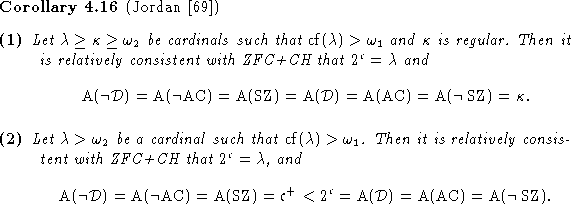
Note also that (4) and (5) of Theorem 4.15, and Theorem 4.12 imply immediately the following corollary.
Finally, the following three classes of functions have been brought to this picture.

 having the
Cantor Intermediate Value Property, i.e., such that for every
having the
Cantor Intermediate Value Property, i.e., such that for every
 and for each Cantor set K between f(x) and f(y)
there is a Cantor set C between x and y such that
and for each Cantor set K between f(x) and f(y)
there is a Cantor set C between x and y such that  ;
;
 having the
Strong Cantor Intermediate Value Property, i.e., such that for every
and for each Cantor set K between f(x) and f(y)
there is a Cantor set C between x and y such that
and
having the
Strong Cantor Intermediate Value Property, i.e., such that for every
and for each Cantor set K between f(x) and f(y)
there is a Cantor set C between x and y such that
and  is continuous;
 having the
Weak Cantor Intermediate Value Property, i.e., such that for every
with f(x)<f(y) there is a Cantor set C between
x and y such that
having the
Weak Cantor Intermediate Value Property, i.e., such that for every
with f(x)<f(y) there is a Cantor set C between
x and y such that  .
.
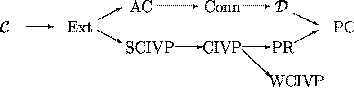
Chart 2: ``Darboux like'' functions.
Clearly the above inclusions, monotonicity of and , and
Theorem 4.10 imply immediately:

The values of functions and for the class , and for
the classes formed by the intersections of with each of the remaining
classes mentioned above were not studied too carefully so far. However,
obviously 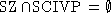 implying

Also, it follows from Theorem 3.10 that

while also

A stronger version of this last inequality follows also from the following
recent theorem of K. Banaszewski and Natkaniec.

In particular,

and 
This last inequality has been recently improved by F. Jordan, who proved the
following.

This theorem gives the
value of for many classes that can be obtained intersecting classes
from Chart 2 and .
Several other operators similar to and have also been studied.
Thus, in 1995 Natkaniec [107] introduced the following operators connected
to the composition of functions, where  stands for the family of all
constant functions.
stands for the family of all
constant functions.

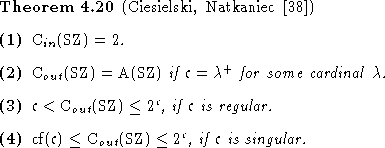
He proved also the following.
Similar functions have been also studied by Ciesielski and
Natkaniec [38]:

where ( ) is the set of all
 for which there exists
  such that
  (
( , respectively). In fact, the class
has the following nice characterization:
, respectively). In fact, the class
has the following nice characterization:

In [38] the authors proved that
Also, in a recent short survey paper [109] Natkaniec evaluated the
values of operators , ,
 and
and  for the class
  of almost continuous functions
in sense of Husain, i.e., such that
of almost continuous functions
in sense of Husain, i.e., such that
 for every non-empty open set
 .
.
Some other cardinal operators connected with composition and
concerning some kind of coding were also studied by
Ciesielski and Rec aw [41],
Ciesielski and Natkaniec [38], and
Natkaniec [109].
Another variant of function is connected to the families of bounded
functions. To define it properly the following notation is necessary. For a
family  let
let
 stand for all uniformly bounded families
 , and let
  be the class of all bounded
functions
. Then we define
be the class of all bounded
functions
. Then we define

In 1994 Maliszewski [94] proved that

so that  . Moreover, he proved that
if all functions in
are measurable (have Baire property), then we can also assume that the
``universal summand'' bounded function has the same property. Similar results
were also proved for families of Borel measurable functions.
. Moreover, he proved that
if all functions in
are measurable (have Baire property), then we can also assume that the
``universal summand'' bounded function has the same property. Similar results
were also proved for families of Borel measurable functions.
The values of  for the other classes of functions from Chart 1 has been
investigated by Ciesielski and Maliszewski [36]. In particular, they proved
for the other classes of functions from Chart 1 has been
investigated by Ciesielski and Maliszewski [36]. In particular, they proved

Notice also that Theorem 4.22 implies immediately
the following corollary.
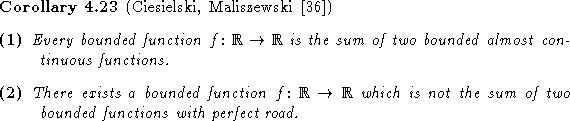
In particular, Corollary 4.23(1) generalizes a
result of Darji and Humke [49] that every bounded function can be
expressed a sum of three bounded almost continuous functions. On the other
hand Corollary 4.23(2) shows that the following result of Natkaniec
is sharp.
It might be also interesting to examine a bounded version of , defined as

However this function has not been studied so far.
One might also consider the study of the operator (and ) for the
functions from  into with n>1. This has indeed been done by
Ciesielski and Wojciechowski in [44]. The study concerned only the classes
into with n>1. This has indeed been done by
Ciesielski and Wojciechowski in [44]. The study concerned only the classes
 ,
,  ,
,  ,
,  , and
, and  since
other classes from Chart 2 do not have natural generalizations into functions of
more than one variable. First, one should recall that for n>1 Chart 1 is not
valid any more. The new inclusions (for n>1) are as follows:
since
other classes from Chart 2 do not have natural generalizations into functions of
more than one variable. First, one should recall that for n>1 Chart 1 is not
valid any more. The new inclusions (for n>1) are as follows:


(The inclusion `` '' was proved by
Hamilton [66] and by Stallings [132], and the inclusion
``
'' was proved by
Hamilton [66] and by Stallings [132], and the inclusion
`` '' by Hagan [65]. The proof of the
inclusion ``
'' by Hagan [65]. The proof of the
inclusion `` ''
is presented in [132]. The
examples showing that
''
is presented in [132]. The
examples showing that
 and
and  can be found
in [105, Examples 1.1.9 and 1.1.10,] or
[104, Examples 1.7 and 1.6,],
while a simple Baire class 1 function in
can be found
in [105, Examples 1.1.9 and 1.1.10,] or
[104, Examples 1.7 and 1.6,],
while a simple Baire class 1 function in
 was described in
[116, Example 1,].) We do not know whether the inclusion
was described in
[116, Example 1,].) We do not know whether the inclusion
 is proper.
The problem with studying the value of the operator for all these
classes (except ) is that there exists a function
 which is not a sum of n Darboux functions, implying that

However, every function function  is sum of n+1 extendable
functions. To express these results nicely, define for
is sum of n+1 extendable
functions. To express these results nicely, define for
 the repeatability
  of as the smallest integer k such that any function
 can be expressed as a sum of k functions from
. (We put
can be expressed as a sum of k functions from
. (We put  if such a number does not
exist.) In this language the results of Ciesielski and Wojciechowski can be
stated as follows.
if such a number does not
exist.) In this language the results of Ciesielski and Wojciechowski can be
stated as follows.

Clearly Theorem 4.25 implies that  .
The problem (stated in [44]) whether this equation can be replaced by the
equality has been recently solved by F. Jordan.
.
The problem (stated in [44]) whether this equation can be replaced by the
equality has been recently solved by F. Jordan.
The value of  is clearly equal to 2, since
Natkaniec [104] proved that
is clearly equal to 2, since
Natkaniec [104] proved that  . This fact has been
recently improved by F. Jordan, who proved
. This fact has been
recently improved by F. Jordan, who proved
Notice also, that in the language of  operator the results from
Theorem 4.24 and Corollary 4.23(2) can be expressed by the
equation
operator the results from
Theorem 4.24 and Corollary 4.23(2) can be expressed by the
equation

where  is the natural generalization of for the
class of bounded functions.
is the natural generalization of for the
class of bounded functions.





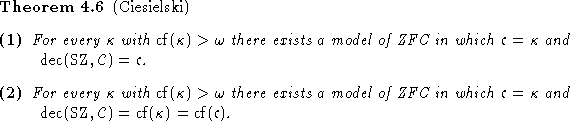
 with
with