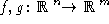
Let X and Y be arbitrary sets. For arbitrary families  and
and
 , where
  stands for the collection of all subsets of a
set Z, define
stands for the collection of all subsets of a
set Z, define

and

If families  and
and  are the topologies on X and Y, respectively,
then
are the topologies on X and Y, respectively,
then  is a well known object: the class of all continuous
functions from
is a well known object: the class of all continuous
functions from  to
to  . Similarly a class of measurable
functions with respect to an algebra of subsets of X is equal to
, where is an appropriate topology on Y.
. Similarly a class of measurable
functions with respect to an algebra of subsets of X is equal to
, where is an appropriate topology on Y.
In both these approaches one starts with families of sets
and and obtain, in return, a family of functions. But what if a class
of functions  is given to begin with? When can we find families
and such that
is given to begin with? When can we find families
and such that  or
or
 ? And how nice can these families be, if they exist?
This questions have been studied recently by several authors. To talk about
their results, let us fix the following terminologies. We say that a family
can be
for some families and ;
for some families and ;
for some topologies on X and on Y;
 and
for some family
and
and
for some family
and  .
.
From all these notions only the problem of characterizing by associated sets
has been extensively studied. Clearly, all classes of continuous function
 from a topological space X into
  (considered with the natural
topology) can be characterized by associated sets. So can be the family of
-measurable functions from X into , for any
(considered with the natural
topology) can be characterized by associated sets. So can be the family of
-measurable functions from X into , for any  -algebra of
subsets of X. However, there are also many examples of classes of functions
that do not admit such a characterization. In fact, the real interest in the
characterizations of functions by associated sets has been initiated by
the 1950 paper of Zahorski [142], in which he tried to characterize
derivatives (from to ) in that way.
-algebra of
subsets of X. However, there are also many examples of classes of functions
that do not admit such a characterization. In fact, the real interest in the
characterizations of functions by associated sets has been initiated by
the 1950 paper of Zahorski [142], in which he tried to characterize
derivatives (from to ) in that way. Today we know that derivatives
cannot be characterized by associated sets: any class
Today we know that derivatives
cannot be characterized by associated sets: any class  that can be
characterized that way has the property that
that can be
characterized that way has the property that  for every
  and every homeomorphism
 ; however derivatives do not have this property. (See
Bruckner's book [15] on this subject. Compare also [16].) This
negative result has been followed by several others, in which the authors prove
that the following classes of functions (from to ) cannot be
characterized by associated sets:
; however derivatives do not have this property. (See
Bruckner's book [15] on this subject. Compare also [16].) This
negative result has been followed by several others, in which the authors prove
that the following classes of functions (from to ) cannot be
characterized by associated sets:
 (Bruckner [14, 1967,]),
 (B. Cristian, I. Tevy [19, 1980,]),
 (Kellum [76, 1982,]),
 (Rosen [115, 1996,]) and the remaining classes from Chart 2
(Ciesielski, Natkaniec [39, 1997,]).
(Rosen [115, 1996,]) and the remaining classes from Chart 2
(Ciesielski, Natkaniec [39, 1997,]).
The question about topologizing different classes of real functions has been
first systematically studied in early 1990's by Ciesielski in [26]. He
starts with the following theorem listing basic properties of classes that can
be topologized. In the theorem
 stands for the set of complex numbers,
 for the class of linear functions f(x)=ax+b,
 for the natural topology on , and
  for the
identity function from X to X.
for the
identity function from X to X.
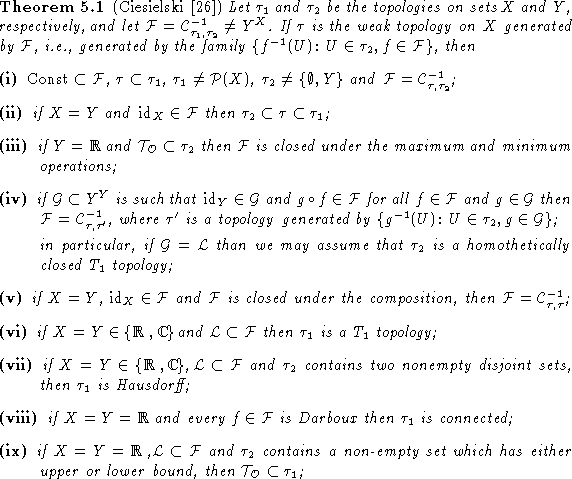
Of all these properties only (iii) needs a little longer
(but still easy) argument. Note also, that (i) shows, that in order to
topologize some family, only the search for the range topology is essential.
Condition (v) shows that the question when topologies
 and
and  can be chosen equal is answered by the following
corollary.
can be chosen equal is answered by the following
corollary.
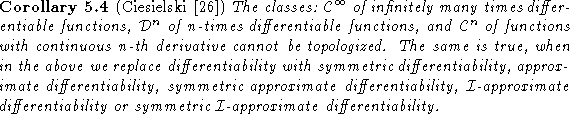
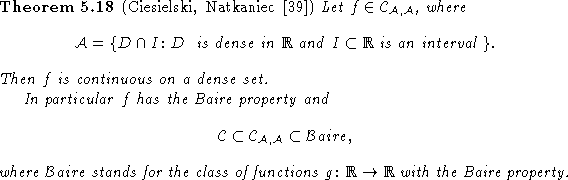
Next, from Theorem 5.1 (conditions (iii), (vi) and (ix)) Ciesielski concludes the following fact
which easily leads to the following corollary:
(The definitions of all classes of functions from this, and the next corollary can be found in [15] and in [35].)
With a little more effort he also concludes
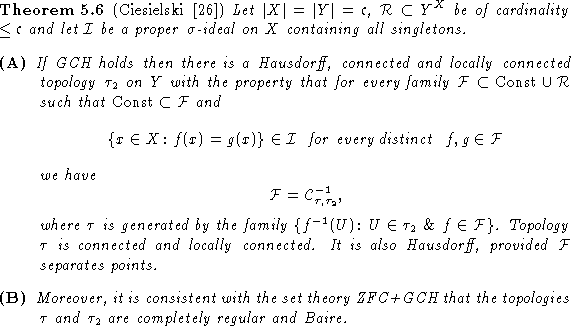
From the positive side, paper [26] contains the following deeper result.
Applying Theorem 5.6 to the
-ideal  of the first category subsets of
  , and using the
fact that for any different harmonic functions
, and using the
fact that for any different harmonic functions
 we have
 we can
conclude that the class of all harmonic functions
we can
conclude that the class of all harmonic functions
 can be topologized.
Another -ideal that can be used with Theorem 5.6 is the
ideal  of at most countable sets. Since for any two different
analytic functions
of at most countable sets. Since for any two different
analytic functions  we have
 , we can also conclude the following
corollary.
, we can also conclude the following
corollary.
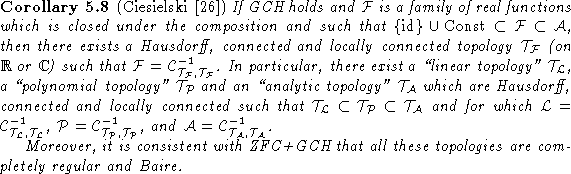
Notice also, that if the family in Corollary 5.7 is closed
under the composition and
 , then, by Theorem 5.1(v),
 . We can write this in the form of next
corollary, where stands for the family of all analytic functions and
. We can write this in the form of next
corollary, where stands for the family of all analytic functions and  for the family of all polynomials.
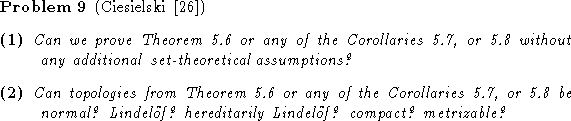
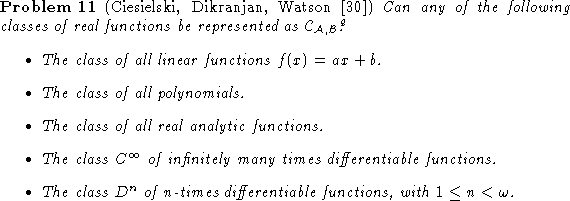
The following questions in these subject are open.
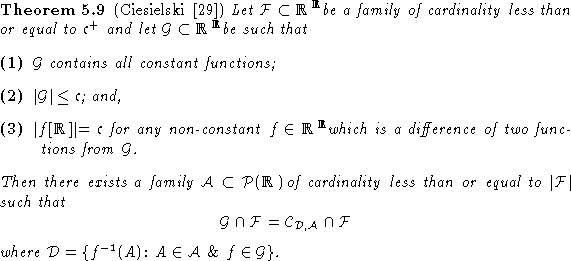
The general problem of characterizing classes of functions by preimages of sets (in a sense defined above) has been studied only in two papers: [29] and [39]. In paper [29] Ciesielski proves the following theorem, which generalizes a similar result of Preiss and Tartaglia [113].
Clearly the family
 of all derivatives satisfies the above conditions (1)-(3). In
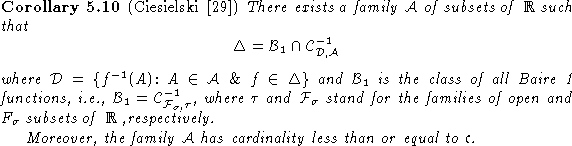
particular, Theorem 5.9 implies the following two corollaries.
of all derivatives satisfies the above conditions (1)-(3). In
particular, Theorem 5.9 implies the following two corollaries.
Note that by Corollary 5.5 the families and in
Corollary 5.11 cannot be topologies. Also, they cannot be algebras:
The following problems remain open.
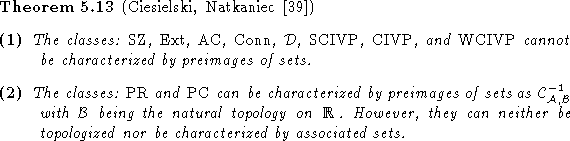
The problem of characterizing by preimages of sets families from Chart 2 has been recently addressed by Ciesielski and Natkaniec.
The problem of characterizing a family of functions by images of sets was first
studied by Velleman for the class  of continuous functions from to
.
of continuous functions from to
.
Note that a family  from Theorem 5.14 is just the family of Darboux
functions.
from Theorem 5.14 is just the family of Darboux
functions.
Theorem 5.14(2) has been essentially generalized by Ciesielski, Dikranjan and Watson in [30]. In this paper the authors list a basic properties of classes that can be characterized by images of sets, which is similar in flavor to Theorem 5.1. Then, they prove the following generalization of Theorem 5.14.
They also remarked that there is a compact subset  , a Cook continuum,
for which
, a Cook continuum,
for which  , and so, it can be characterized by images of sets.
For
the classes of functions from to , their
generalization of Theorem 5.14 appears as
follows.
This, in particular, implies the following corollary.
They
also noticed that the class of Darboux functions can be
characterized by images of sets. (It is defined that way.)
It has been also recently noticed by Ciesielski and Natkaniec [39] that in Theorem 5.15 the clause ``non-measurable'' cannot be replaced by ``without the Baire property.'' More precisely, they proved
Finally,
Ciesielski and Natkaniec [39]
proved that it is impossible to characterize
by images of sets the classes  , and
, and  of
functions (from to ) with the Baire
property. They also proved the following theorem.
of
functions (from to ) with the Baire
property. They also proved the following theorem.
The following problem in this area remain open.
Another interesting problem (loosely related to real functions, but having the
same flavor that the topologizing question has) concerns the existence of a
topology on a given set
X, often the real line, satisfying the best possible separation axioms, for
which a given ideal (-ideal) of subsets of X consists precisely of
sets that are nowhere dense (or first category) in X. Ciesielski and
Jasinski [31, 1995,] obtained several positive results in this direction
under some additional set-theoretic assumptions. The problem was also
investigated in the papers [114] by Rogowska and [4] by Balcerzak
and Rogowska.
There are also many interesting theorems concerning different classes of
functions  , where
 is equipped with some abstract topology refining of the natural
topology. A survey of some recent results in this direction can be found in the
last issue of the Real Analysis Exchange [64]. The topologies on
that were
most studied in this aspect in recent years are the
is equipped with some abstract topology refining of the natural
topology. A survey of some recent results in this direction can be found in the
last issue of the Real Analysis Exchange [64]. The topologies on
that were
most studied in this aspect in recent years are the  -density
topology (defined in 1982 by Wilczynski [141])
and the deep
-density topologies
(defined in 1986 independently by
-density
topology (defined in 1982 by Wilczynski [141])
and the deep
-density topologies
(defined in 1986 independently by  azarow [91], and by
Poreda and Wagner-Bojakowska [112]).
These are category analogues of the density
topology. The survey of the results in this direction can be found
in a monograph of Ciesielski, Larson and Ostaszewski [35].
(In particular, see [32] or [35, Sec. 1.5,]
for some set theoretic results and open problems concerning these topologies.)
azarow [91], and by
Poreda and Wagner-Bojakowska [112]).
These are category analogues of the density
topology. The survey of the results in this direction can be found
in a monograph of Ciesielski, Larson and Ostaszewski [35].
(In particular, see [32] or [35, Sec. 1.5,]
for some set theoretic results and open problems concerning these topologies.)